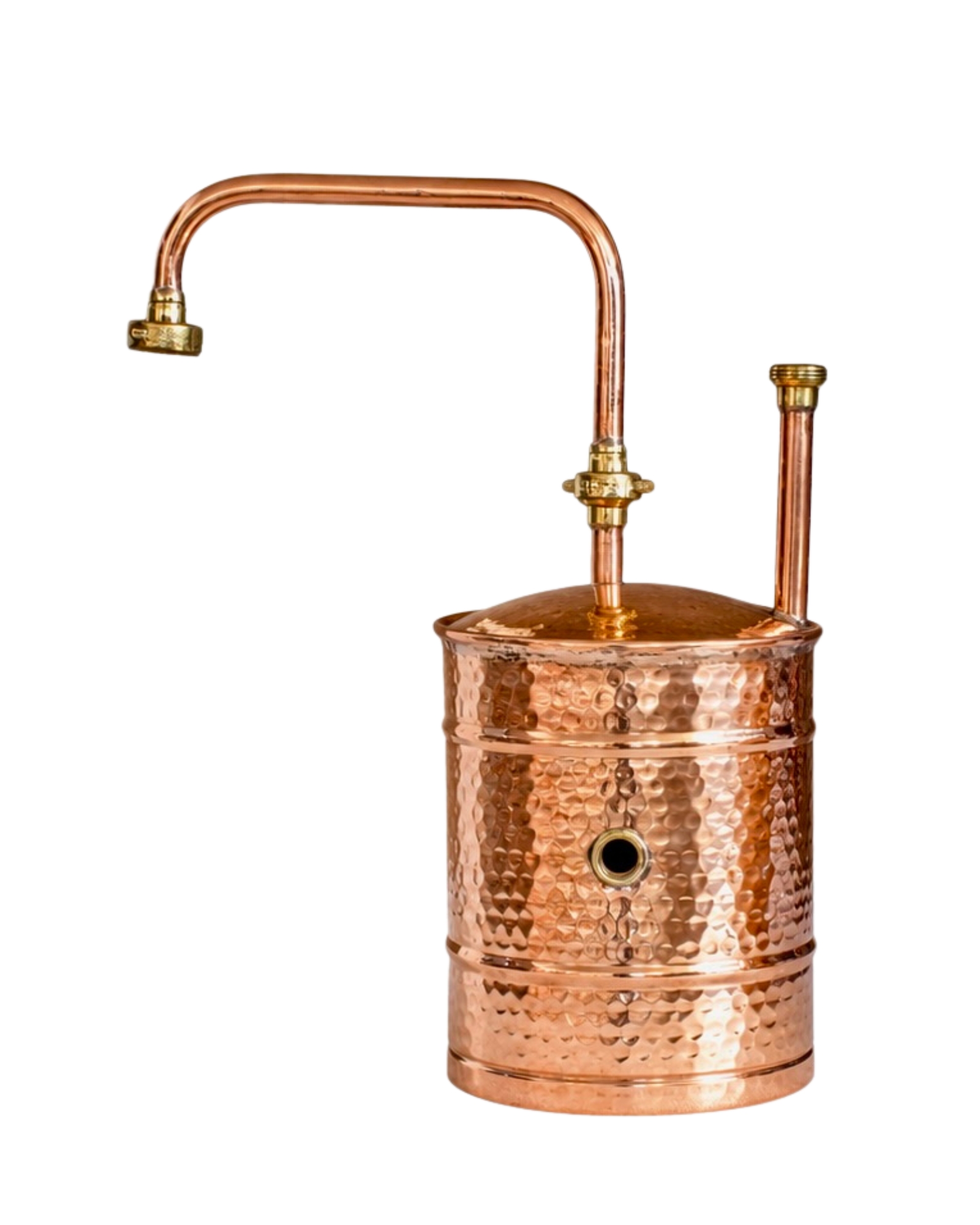
Copper Thumper
From $1,150
Our copper thumpers are out of stock. If you’d like to order one just get in touch.
Thumpers (or thumper kegs) are used in alcohol distillations to increase the ABV of the distillate and can also be used to add flavour to your spirit. It’s called a thumper because of the sound it makes as it does its work.
Thumpers are useful for spirit distillers who would like to reduce re-distillation runs and streamline their distillation process. They are also good for adding flavour in rum distillations and can be used for gin flavouring runs.
How they work
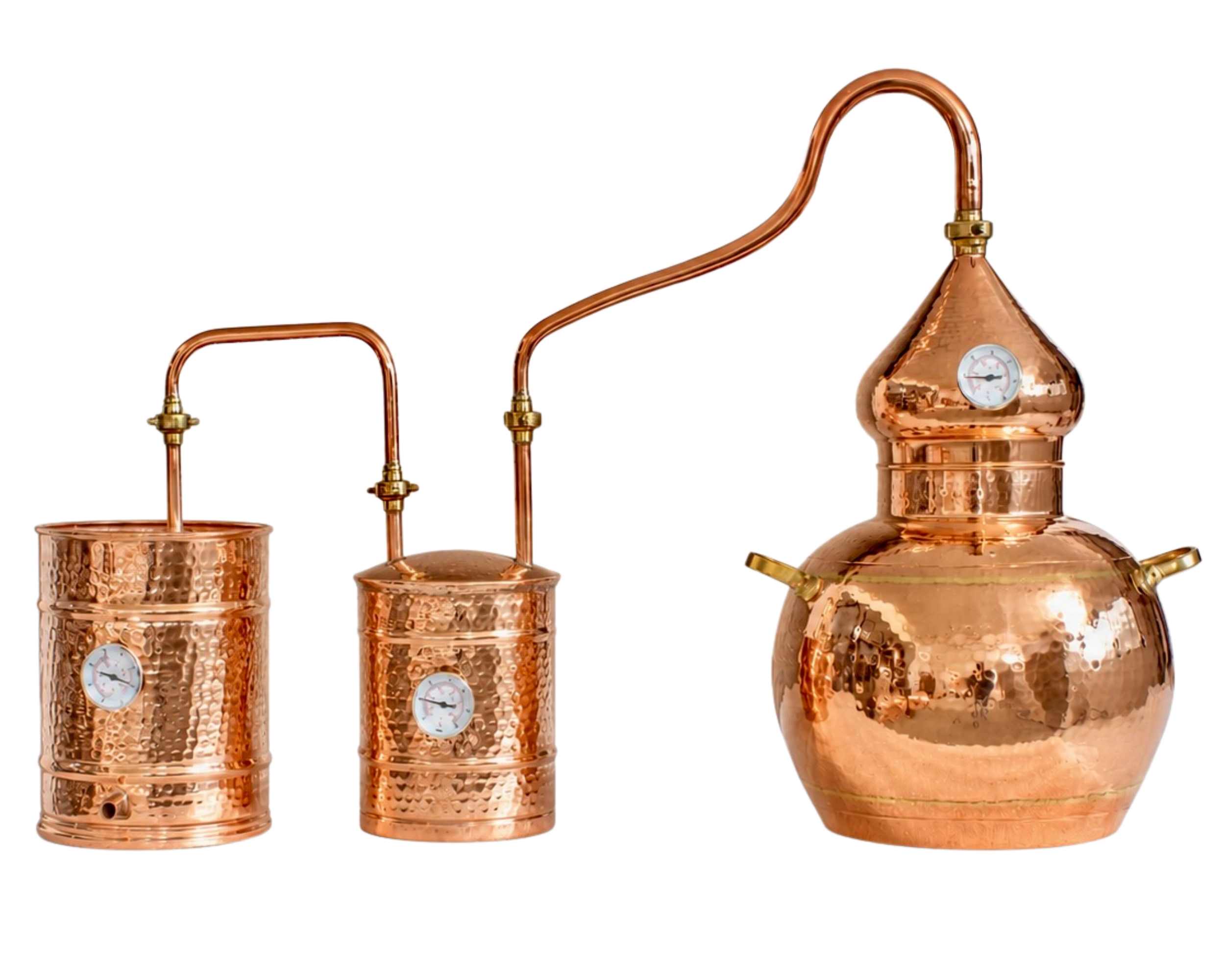
Adding a thumper acts as a built-in second distillation. It’s partially filled with liquid (low wines, spirit or even water) and placed between the pot still and the condenser. It uses the heat of the distillate emerging from the pot still to perform its secondary distillation before the distillate passes through the condenser and to the outlet pipe.
Pot stills alone typically deliver 35–45% ABV from 8–10% low wines in a single distillation. With the addition of a thumper it’s possible to distil to 60–75% ABV. (Your results will vary depending on the type of still used, the percentage ABV of your low wines, and what liquid you place in your thumper).
For flavour
You can also place botanicals into the liquid in your thumper (or suspend them above) to infuse more flavour into your spirit. Some distillers use spices and fruits, while others charge their pot still with 40% neutral spirit and use the thumper as a gin basket.
Thumper or reflux still?
Choose a thumper if you are distilling spirits for flavour. A reflux column gives better separation between cuts and 95% alcohol, versus the comparatively low, flavor-retaining output of a thumper setup.
Benefits
- Cuts down the number of additional distillations needed for spirit runs.
- Does not need an additional heat source.
- Can also be used to infuse flavour into your spirit.
- Can be used for gin flavouring runs.
Use with: Traditional alembic stills, whisky stills,
Comes with:
Outlet pipe and thermometer.
Optional: can be fitted with tri-clamps on request.
Sizes:
For 10L stills: 2.12L
For 20L stills: 6.6L
For 30L stills: 7.7L
For 40L stills: 13.5L
For 50L stills 16.6L
Larger sizes available on request.
Our copper columns are all handcrafted in a small artisan factory just outside of Porto. We are fortunate to be able to get a shipment each year, as demand worldwide for these beautifully crafted stills has increased dramatically.
FAQ's
Alembics offers free shipping on all products NZ-wide.
We are committed to providing prompt and friendly service, and aim to dispatch orders as soon as possible after we receive payment. Parcels can take up to 7 working days within New Zealand. We ship with NZPost or Sealink Logistic.
If you are purchasing from overseas there will be a freight cost for your still. If this is not processed at checkout we will contact you with a shipping quote.
Australia—Shipping costs are currently calculated at checkout for all our Australian customers.
Rest of the world—As shipping costs vary depending on package size, destination and carrier we advise other international customers to contact us, and we’ll provide you with a shipping estimate for your location. Please don’t hesitate to get in touch, we are happy to help.
Shipping times—We are committed to providing prompt and friendly service, and aim to dispatch orders as soon as possible after we receive payment. Shipping times are variable depending on destination. We ship with NZ Post or Sealink Logistics or Golandseaair Logistics. You can also request express shipping via DHL.
If you are an international customer, you may have to pay tax or duty on your purchase at the port of entry.
We do our best to carefully pack stills to protect them from damage—that’s why we use a lot of packaging, though as much is recycled as possible (we’ve found egg cartons work a treat). But copper is a soft, malleable metal and rough handling by courier companies can sometimes result in small dents. These can be easily tapped out by covering a hammer head with a cloth and gently tapping the inside of the dent until it pops out.
Please contact us if there is extensive damage and we will replace your still.
All our copper stills are made in Portugal with the highest-quality materials and have brass handles and fittings. The thickness of our copper ranges from 0.7mm to 1mm depending on the size and style of the still.
Copper is a precious metal prized by alchemists and distillers for centuries. Throughout time, ancient and modern cultures alike have valued copper for its superior purifying qualities. Spirits from copper stills taste better: cleaner, and purer than their steel counterparts. Copper also has a strong aesthetic appeal that many people are invariably drawn to.
Yes, if a still is out of stock, you will see a note on our product page about pre-ordering (including any benefits, discounts and estimated arrival dates).
If you have pre-ordered a still, our friendly team will contact you with the estimated date of arrival, or if you’d like to know more in advance, get in contact with us.
Alembics is committed to supplying you with top-quality products and friendly, helpful service. All our copper stills are of the highest quality.
Alembics is a small, New Zealand registered business. We’ve been operating since 2009. By supporting us you’re supporting local kiwis and their families.
Being a New Zealand registered business means we uphold the Consumer Guarantees Act of 1993, so if anything happens to your purchase we’ll do what it takes to set it right.
Copper alembic stills come in all shapes and sizes. Finding the right one for you depends on what you are planning to distil, and what volume you want to produce.
This helpful free video on Types of Stills runs you through the main types of stills we use at Alembics, and what they are best suited for. It’s designed to help you decide which still is best for you.
Get in touch if you need any help. We’re more than happy to discuss what you want to achieve, and suggest which still we think will be best suited for the job.
An important note on sizing: The stills size (3L, 5L etc…) refers to the total volume of the still’s pot or boiler, not the max fill volume or the yield/output you will get (which will be less).
Stills have a minimum and maximum fill level (30% and 80% respectively). So for a 3L still the minimum fill is 900ml (30%) and maximum is 2.4L (80%). See the full table here.
The size you choose will depend on what you want to produce. Helpful questions to ask yourself include:
Are you distilling for fun at home or are you looking into product development? You may suit a small still for experimenting and trial runs.
When beginning, we often recommend people start out with small stills (anywhere from 3–10L) because:- They’re easy to set up
- It’s a relatively small capital outlay
- They use smaller amounts of plant material
- They take less time, as these are relatively quick distillations
It’s a great way to learn the techniques and discover where you want to go with distillation. Because it’s very hands-on, you’ll get a great grounding in the mechanics of distillation that will allow you to become confident in your process, and that will serve you well when you size up.
Do you have access to a lot of botanical resources, or are you planning on using what you can grow in your own garden? You can achieve a lot with small stills—great for batch distilling where you can run several distillations a day in times of plenty. If you have large resources, larger stills (10L plus) and longer distillations may be more efficient for you.
Are you planning on setting up a small business, artisan distillation outfit or producing essential oils for a small business? You may want to look into some of our larger sizes (10L plus).
Please get in touch if you need help. We’re more than happy to discuss what you want to achieve, and suggest which one we think will be best suited for the job.
- Heat source
- Submersible water pump and plastic tubing
- Water receptacle
- Beakers, measuring tools and botanicals
We often recommend that those new to distilling purchase one of our distillation kits, as they arrive at your door with everything you need to begin distilling.
Distillation kits are available for a variety of still types and sizes—we offer hydrosol, essential oil, spirit and gin kits. These include your still, submersible pump and hose, and relevant specialist equipment (such as an alcohol kit where applicable).
Pumps and hotplates are set to New Zealand wall sockets. If you are purchasing from overseas you will also need a wall adaptor.
It is essential to clean your new still before you start distilling, to make sure it’s free from all residue left over from the manufacturing process.
We always recommend using a rye flour slurry (rye flour mixed with hot water) for the first clean. This may sound odd, but time-and-time again we see that a good rye flour clean is the most effective, simple and natural way to remove the dust and linseed oil residue that is part of the copper manufacturing process.
Our stills are sealed with a food grade, linseed oil base glue. The rye flour clean will remove any loose dust from manufacturing, however if you see any flakes in your still after other distillations do not worry, the glue is not volatile and will not affect your distillation. Please do not scrub the glue seal with abrasive items as this may cause your still to leak.
For ongoing best results, we also recommended that you follow our maintenance processes and cleaning tips before beginning a new distillation.
We’ve put all this information together for you in a free Still Cleaning & Care video that demonstrates set up, cleaning and maintenance (including the initial rye flour clean).
Note: our smaller stills are joined by riveted unions. This not only gives them an attractive appearance but acts to strengthen them. To seal the rivets and protect stills from leaks a food-grade linseed sealant is used on the inside of the still. This will wear away over time. Don’t be surprised to see some small flakes in the bottom of the pot, post-distillation. These particles are too heavy to come across in the distillate, and if you follow our cleaning recommendations shouldn’t be detectable at all.
Alembics is dedicated to helping people to enter distilling, starting on a small and sustainable scale.
You’ll find a list of resources on our How To page, including links to these free resources:
- Our free videos on how to choose a still, and assembly, set up and clearing.
- Our Archive of recipes, articles and distillation tips
- A Glossary of distillation terms.
- The Encyclopedia Botanica, our ever-expanding resource on aromatic plants and their uses.
You can also learn how to distil hydrosol, essential oil, alcohol and gin with us in our online courses at The Alembics Lab. Or keep your eyes out for live in-person workshops near you.